
95% of your GPU is idle
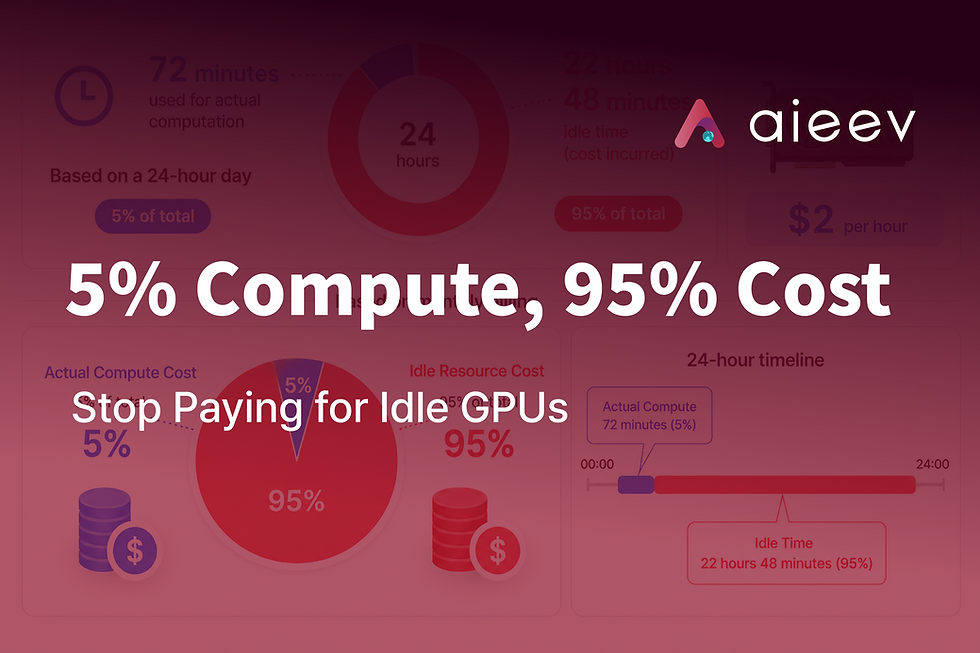
You're only using 5% of the GPUs you paid for
As of April 2026, GPU utilization in enterprise Kubernetes clusters ranges between 5% and 30%. Despite costing $2 to $15 per hour depending on the hardware, most GPUs remain idle for the majority of the time. According to a Cast AI report, companies are spending up to 20× more than what they actually need for GPU compute. In the race to adopt AI, many organizations secure GPU capacity “just in case.”But simply holding onto that capacity is already driving costs up.

So why are GPUs sitting idle?
The problem isn’t technology. It’s structure. Kubernetes, by default, allocates GPUs as whole units. Once a GPU is assigned to a workload, it becomes difficult for others to share it—even if it’s not being fully used. Model training might only take a few hours a day, but the GPU often remains allocated for much longer. Teams tend to over-provision for peak scenarios, and without clear visibility into real-time usage, it’s hard to scale things back.
![[AI-Generated Image] Cost structure driven by 5% GPU utilization](https://static.wixstatic.com/media/8910cc_58c94f0fafed4f339b882132131f42ce~mv2.png/v1/fill/w_980,h_653,al_c,q_90,usm_0.66_1.00_0.01,enc_avif,quality_auto/8910cc_58c94f0fafed4f339b882132131f42ce~mv2.png)
If you run a $2/hour GPU at 5% utilization,you’re only using it for 72 minutes a day. The remaining 22 hours and 48 minutes? You’re still paying for it.
In other words:
5% of your bill = actual compute
95% = idle capacity cost
What makes this worse is that the waste is hard to see. Cloud bills are split across teams, and each team assumes their usage is reasonable. The full scale of inefficiency only becomes visible when you look at the entire organization.
How can we use GPUs more efficiently?
There are two main approaches.

1) Internal optimization
This includes techniques like GPU time-slicing, MIG (Multi-Instance GPU) partitioning, and cross-team resource sharing policies. The goal is simple: extract more compute from the resources you already have.
![[AI-Generated Image] Evolution of infrastructure architecture](https://static.wixstatic.com/media/8910cc_c625eb704c9b405b81641155e3ace647~mv2.png/v1/fill/w_980,h_465,al_c,q_90,usm_0.66_1.00_0.01,enc_avif,quality_auto/8910cc_c625eb704c9b405b81641155e3ace647~mv2.png)
2) Rethinking ownership
Instead of owning GPUs, you access them only when needed. With serverless infrastructure, resources are allocated on demand and released immediately after the job is done. There is no cost for idle time. At this point, a natural question emerges: “Then where should GPUs actually live?” Traditionally, the answer was simple:data centers. But that assumption is starting to break. Today, we can connect not only underutilized enterprise and data center resources, but also individually owned GPUs and AI-optimized edge devices, forming a distributed cloud.
Air Cloud is built on this idea.
It combines:
internal optimization to maximize individual resource efficiency
and distributed architecture to improve system-wide utilization
Ultimately, the goal is not to own more GPUs,but to use existing ones more intelligently.
The real signal behind 5% GPU utilization
This issue goes beyond cost. It reveals a deeper structural inefficiency. In South Korea, data center concentration is becoming a serious problem. Around 70% of data centers are located in the Seoul metropolitan area, and over 80% of new applications are also concentrated there.
This has led to growing concerns around power bottlenecks and infrastructure limitations in specific regions.
And here’s the irony:
GPU utilization is only 5%, but the data centers supporting them consume 100% of the power.
Even when GPUs are idle, they still require electricity and cooling. So in practice:
Companies pay for unused GPU capacity
Entire regions absorb unnecessary energy demand
This is not just inefficiency—it’s a structural mismatch between how AI workloads behave and how infrastructure is built. AI workloads are not constant. Training is finite.Inference fluctuates with demand. Yet infrastructure is still operated as if everything must run 24/7.
In 2025, the challenge was:“How do we secure enough GPUs?” In 2026, the question shifts:
“How do we use them properly?” Moving from ownership to access,from centralized to distributed systems — This is not just an optimization.It’s a structural shift in how AI infrastructure works.
| Experience AIEEV’s distributed cloud today.
💰 Pricing
*Reference
AI Infrastructure Spending to Reach $758Bn USD Mark by 2029 ('25, IDC)
CIO.com GPU Utilization Analysis (Apr 23, 2026)
Status of Data Centers in Korea (2023), Korea Data Center Council


